What Does It Actually Mean to Be Human Our Scriptures Have an Answer.
It all started one day when I was watching a TV show. A character in the show said, "A Saint told me to leave everything behind, because it is all just an illusion." At the same time I remembered, some activists on social media say we should just focus on being good humans instead of following specific groups. In this blog, let's look at what our scriptures actually teach us about our duties. Do they tell us to be a Hindu, or do they tell us to be a human and what a Human is?
Author: Eshan Singh
6 min read
·Published: 21 June, 2026
That dialogue from the show stayed in my mind. People keep talking about being "human," but what exactly is a Human (Manuṣya). So, I decided to do some research, and this is what I found.
Who is a Human?
मनुष्य: कस्मात्। मत्वा कर्माणि सीव्यन्ति। मनस्यमानेन सृष्टाः। मनस्यतिः पुनर्मनस्वीभावे। मनोरपत्यम् मनुषो वा
In the Nirukta 3.2.2, Maharishi Yāska explains that "a Manuṣya (human) is someone who thinks carefully before they act. It also means someone created by the greatest thinker (Almighty), someone who has intelligence, or a descendant of Manu(or Manuṣa).
This gives us four distinct dimensions of what it means to be human. From now on, I will use the word "human" instead of Manuṣya, as this will be easier for everyone to read.
Now a question comes to mind. According to these definitions, we know we are created by the Almighty and that we are the descendants of Manu. But the other definitions say a human is someone who thinks before they act. Do we really think before we act? And if we do think, how do we know what is right and what is wrong? What should we think about? To solve this problem, the Rishis gave us a word called Dharma (Righteousness), which means doing the right things or our right duties.
So we know what a human is. But knowing what we are is only half the answer. The real question is, what are we supposed to do?
What are the duties of a Human?
धारणाद्धर्ममित्याहुर्धर्मो धारयति प्रजाः । यः स्याद्धारणसंयुक्तः स धर्म इति निश्चयः ॥
In Mahabharat 8.49.50, "Dharma is what holds up, sustains, and supports life and society".
In Manusmriti 6.92, Yajyavalkya Smriti 1.122, Yogstra 2.30-32 , the Maharishi Manu, Yajnavalkya, and Patanjali all explain these core duties. These are the actions of an ideal human. These duties are not complicated.
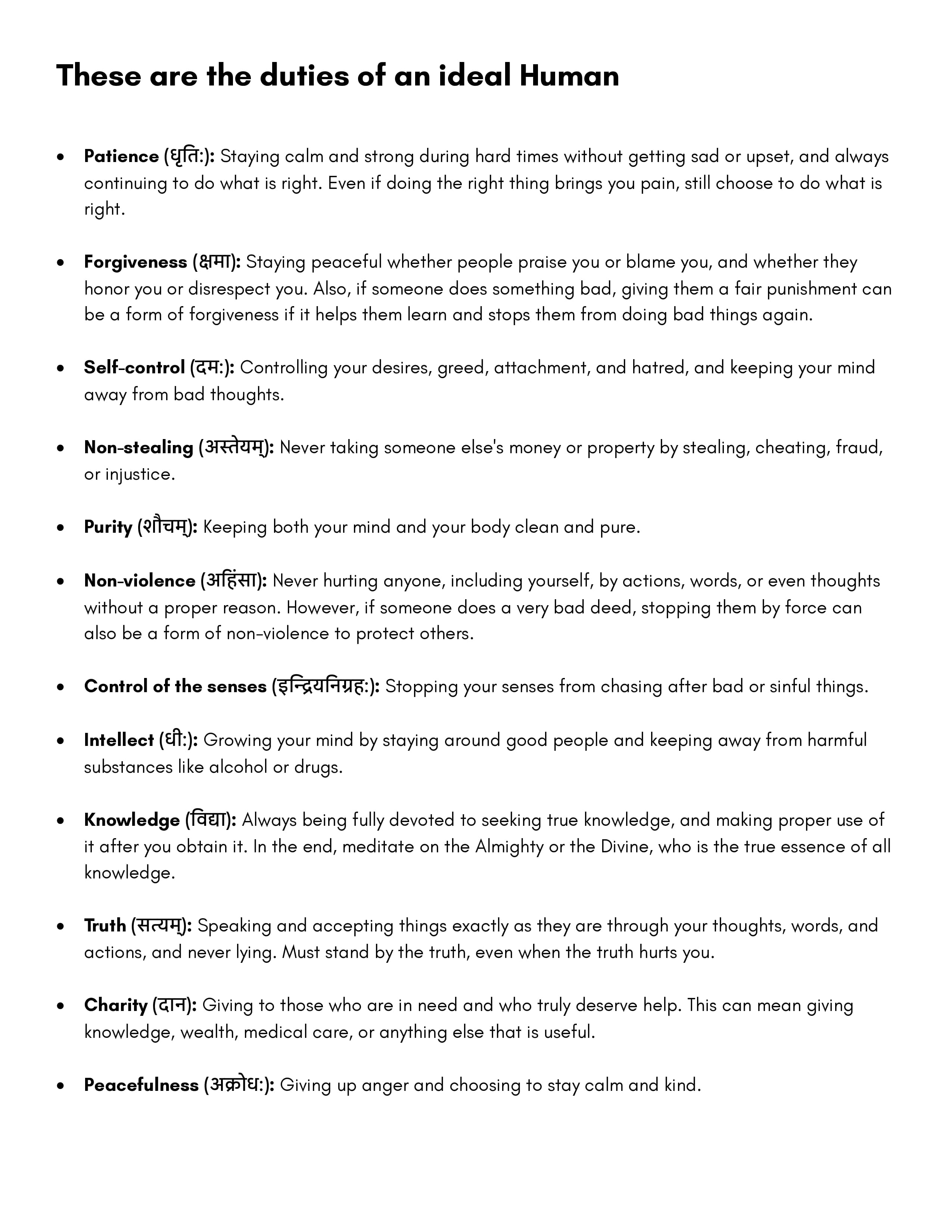
धृतिः क्षमा दमोऽस्तेयं शौचमिन्द्रियनिग्रहः । धीर्विद्या सत्यमक्रोधो दशकं धर्मलक्षणम्
Patience means staying calm and doing the right thing even when it hurts. Forgiveness means not letting anger control you. Self-control means keeping your mind away from greed and hatred. Non-stealing means never taking what is not yours, whether by force, fraud, or dishonesty. Purity means keeping your body and mind clean. Non-violence means not hurting anyone including yourself through actions, words, or thoughts unless justified by a righteous cause (like self-defense or protection of others). Control of senses means not chasing things that harm you.
Intellect means staying around good people and away from bad habits. Knowledge means seeking truth and using it well. Truth means saying and accepting things exactly as they are, even when it is uncomfortable. Charity means giving to those who truly need it. And Peacefulness means choosing calm over anger, always. For a more detailed look at each duty, see or download the image below.
But these words can feel very heavy, and sometimes it is hard to understand or follow them.
A simple way to understand Dharma is something we can hold within ourselves. Even simpler, it means treating others the way we want them to treat us and our loved ones. There are many deep arguments about this, but this simple idea still helps us understand our right duties.
Dharma is also flexible depending on your role in life. For example, if you are a soldier, you might have to fight an enemy who has never personally harmed you. In that moment, protecting your country is your duty, and that is exactly what Lord Krishn taught Arjun.
What the Scriptures Actually Say
One common idea promoted by politicians, actors, and online influencers is that all books teach the same thing. However, this is not true. The teaching that follows is found only in the Vedas:
मनु॑र्भव
सं ग॑च्छध्वं॒ सं व॑दध्वं॒ सं वो॒ मनां॑सि जानताम् । दे॒वा भा॒गं यथा॒ पूर्वे॑ संजाना॒ना उ॒पास॑ते
Rigveda 10.53.6 and Rigved 10.191.2 says: "Become human." This means we must be thoughtful and follow Dharma. Remember, Dharma means the right duties we talked about earlier, not just a religion. It also teach: "O Humankind! Let your actions, words, and thoughts be in harmony as one."
A common misconception often circulated by casual spiritual commentators is that because the Divine is omnipresent and resides within everyone, every action including harmful or malicious deeds, is ultimately done by the Divine. This argument fundamentally misunderstands the concept of free will as laid out in the texts:
कर्मण्येवाधिकारस्ते मा फलेषु कदाचन। मा कर्मफलहेतुर्भूर्मा ते सङ्गोऽस्त्वकर्मणि
From Bhagvad Geeta 2.47, we can understand that, We humans are responsible for our actions, while the result are not entirely in our control. And the Divine's role is simply to give us results based on what we do. This means the Divine does not force anyone to do good or stop doing wrong. Rather each person is free to choose their actions and must face the consequences of their choices.
Think of it like a teacher watching an exam. You might write nonsense or music lyrics on your paper, and the teacher watches you do it. The teacher does not say anything or stop you, because what you write is your choice. But when the test is over, the teacher will give you marks based exactly on what you wrote.
If the Divine never stops someone from doing wrong, what is the purpose of the Divine?
यदा यदा हि धर्मस्य ग्लानिर्भवति भारत । अभ्युत्थानमधर्मस्य तदात्मानं सृजाम्यहम्
While verses like Bhagavad Gita 4.7–8 are often interpreted as promises of physical divine incarnation appear to save good people and destroy evil. But if you think deeply, one way to understand this that the Divine is already present everywhere and does not need to incarnate to teach or save us. The Divine is already inside you. The Divine fills your mind with fear, doubt, and sadness to stop you from doing bad things and to save the good inside you.
But people often ask why criminals live freely while victims suffer. A criminal's actions belong to them alone. But if society stays silent and does not punish wrong, that silence becomes its own failure. Keep in mind that today or tomorrow, these criminals will definitely suffer. You might not see it happen, but they will, because the Divine is justice. The Divine never discriminates and never forgives wrongdoing. Even if you do good deeds or pray to the Divine, if you have done wrong, you will be punished, no matter how or when.
Furthermore, there is a widespread, superficial view of spirituality that insists true progress requires people to leave everything behind and donate all their possessions. This teaching goes completely against what our scriptures say.
शत॑हस्त स॒माह॑र॒ सह॑स्रहस्त॒ सं कि॑र। कृ॒तस्य॑ का॒र्य॑स्य चे॒ह स्फा॒तिं स॒माव॑ह ॥
Atharvaveda 3.24.5 clearly says to earn wealth with a hundred hands through hard work and to use it for good.
Conclusion
The Vedas never asked you to abandon the world or dissolve into vague spirituality. They asked you to think, act rightly, earn honestly, and treat others the way you wish to be treated. That is what it means to be human. Dharma is not a burden handed down by priests or politicians. It is the law already written inside you, the same law that makes you uncomfortable when you lie and restless when you sit idle while others suffer. You do not need to leave behind your life to find it. You need to live it better.