The Name of the Divine: Why Nothing Equals AUM
We say Divine has many forms, but all stem from one supreme Brahman. If He is the ultimate, what is His true name? And why does one sacred sound precede all mantras? Let’s explore this universal root of unity, strength, and knowledge to discover why this sound is the heart of all existence.
Author: Eshan Singh
7 min read
·Published: 21 May, 2026
Since childhood, I always wondered why “AUM” or “OM” is chanted everywhere. It is chanted in temples, heard in yoga classes, spoken before mantras, and repeated during meditation. Every ritual seems to begin with it. Even people who do not know Sanskrit still recognize the sound. That made me curious: what is AUM actually, and why has it used in almost every spiritual tradition that came out of Bharat?
I had often heard that Lord Ganesha is worshipped first before every ritual and prayer. If Ganesha comes first, then why do people still chant “Om” before even his mantra, like “Om Gan Ganapataye Namah” or “Om Ganeshaya Namah”?
As I started reading scriptures and listening to different teachers, I noticed something interesting. Most names of Divine describe a quality, form, or relationship. For example, Krishna refers to the all-attractive one, Shiva to the auspicious one, and Ganesh to the lord of the ganas (people). Each name points toward a particular aspect of the Divine.
This made me curious what is this "AUM" or “OM”.
What is AUM?
हि॒र॒ण्मये॑न॒ पात्रे॑ण स॒त्यस्यापि॑हितं॒ मुखम्। यो॒ऽसावा॑दि॒त्ये पु॑रुषः॒ सो᳕ऽसाव॒हम्। ओ३म् खं ब्रह्म॑
According to Yajurved 40.17, Divine himself state "I am the transcendental Brahman, all-pervading like space, supreme in action and nature. Know my true name as AUM, the protector of all" that his name is "AUM".
ओमित्येतदक्षरमिदं सर्वं तस्योपव्याख्यानं भूतं भवद् भविष्यदिति सर्वमोङ्कार
Mandukya Upnishad states "AUM is the eternal reality comprising the past, present, future, and all that exists beyond time. It is the universe and its absolute truth." The Vedas, Upanishads and almost every Aarsh (written by Rishi's) scripture describe AUM is the name of divine, also the fundamental sound of existence itself. Rishi's called it the primordial vibration, the sound from which creation began.
तस्य वाचकः प्रणवः तज्जपस्तदर्थभावनम् ततः प्रत्यक्चेतनाधिगमोऽप्यन्तरायाभावश्च
In Yogsutra 1.27-29 Maharishi Patanjali says, "The sacred word for the Divine is the syllable AUM. Through its constant repetition and contemplation, one attains self-realization and the resolution of all obstacles." Rishi's believed that before words, forms, and even thoughts existed, there was this subtle cosmic vibration. AUM became the closest expression of that reality in human speech.
Why is AUM the best name for Divine?
Divine has thousands of names like Brahma, Vishnu, or Shiva.
सर्वे वेदा यत्पदमामनन्ति तपांसि सर्वाणि च यद्वदन्ति। यदिच्छन्तो ब्रह्मचर्यं चरन्ति तत्ते पदं संग्रहेण ब्रवीम्योमित्येतत्
Katho Upnishad (2.14-17) states "AUM is the supreme name of Divine, encompassing all His qualities. It is the holiest syllable; meditating upon it fulfills one’s deepest desires. As the highest spiritual support, reciting AUM connects the seeker to the Divine, leading to greatness and universal reverence." and many other scholars say AUM is the highest and primary name.
This is because most other names only describe one part of Divine. For example, the name Brahma means Divine is the creator, and Vishnu means He is everywhere. But the name AUM is like a complete package. It includes everything Divine does in just one sound. It covers the starting, the middle, and the end of everything.
Another reason it is the best name is that it belongs only to Divine. Other names like "Agni" (fire) or "Vayu" (wind) can be used for things we see in nature, like actual fire or the air we breathe. But "AUM" is a personal name that refers only to the Supreme Being.
How is the word AUM made
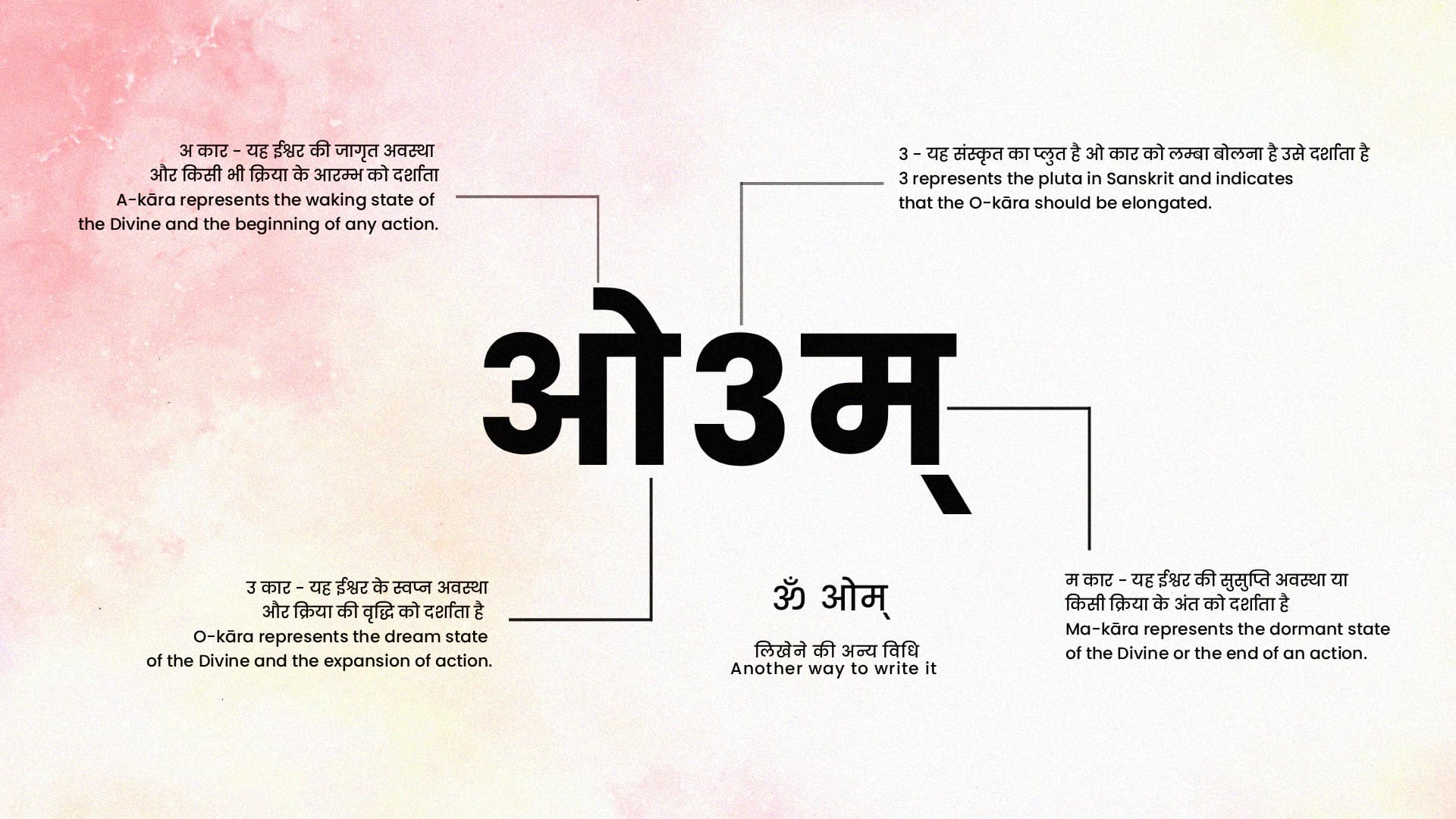
AUM is actually made of three smaller sounds. These are "A" (अ), "U" (उ), and "M" (म्). Each of these letters has a very deep meaning. When you say "A," your mouth opens naturally to start a sound. When you say "U," you narrow your lips to keep the sound going. Finally, when you say "M," you close your lips to finish the sound. This matches how the world works. "A" stands for the beginning or creation, "U" stands for the growth or keeping the world running, and "M" stands for the end or peace.
When you see the symbol for AUM written in Sanskrit, you will often notice a small "3" next to it. This "3" is not just a digit; it is a grammatical instruction. To understand this, we must look at how Sanskrit classifies sound duration: hrasva (short), dirgha (long), and pluta (prolonged). This is similar to how we learn the difference between choti e (इ) and badi ee (ई) in primary school.
In this context, the "3" indicates that the sound must be extended. In Sanskrit, this symbol means you should hold the sound for three times the duration of a short vowel. This is why AUM is chanted as a long, flowing "Oooooooomm" during meditation.
One of the most amazing things about AUM is that it is a natural sound. You do not even need a tongue to say it. This means anyone can say it, from a tiny baby to someone who cannot speak other words. It is a gift for every human being. Even scientists at NASA once recorded a sound from a black hole in space that sounded very much like the vibration of AUM. This shows that the sound is everywhere in the universe.
The Vedas are the oldest books of knowledge, and AUM is considered their essence. All the lessons of the four Vedas can be squeezed into three main topics: knowledge, action, and worship. These three topics match the "A," "U," and "M" in Om. So, when you say Om, you are essentially remembering the wisdom of all the holy scriptures at once.
Why chant AUM and where has it been lost?
Nowadays, people often chant names like "Radhe Radhe" or "Ram Ram" as mantras. Many modern gurus claim that chanting these names is the only way to attain liberation or happiness in the Kaliyuga. However, as we have read till now, AUM is the supreme name of the Divine. While there is no harm in chanting other names, but we should prioritize the teachings of the Rishis, and earlier scholars. These specific sectarian chants emerged only after Hinduism divided into groups like Vaishnavism, Shaivism, Shaktism, and others, which has led to division rather than unity.
ओमित्येकाक्षरं ब्रह्म व्याहरन्मामनुस्मरन् । यः प्रयाति त्यजन्देहं स याति परमां गतिम्
When every guru claims their specific mantra is the best, it creates further fragmentation. AUM, however, is the common thread in every tradition; it serves as a symbol of unity and a return to our roots. In the Bhagavad Gita (8.13), Krishna states: "He who closes the doors of the senses, confines the mind within the heart, draws the prana into the head, and engages in the practice of yoga, uttering the single syllable AUM and meditates on Me(Brahman), attains the Supreme Goal." Similarly, the Yajurveda (40.15, 2.13), the Gopatha Brahmana (Kandika 28-30), and the Yoga Sutras (1.27-1.28, 1.32) all emphasize that meditating on AUM and maintaining faith in it removes obstacles and leads to liberation.
Conclusion
AUM is a profound bridge between the self and the Divine. In Sanskrit grammar, gender usually depends on a word's nature, but AUM is beyond such limits. While the word "Pranava" is masculine, the sound of AUM itself is genderless, much like the Divine, which is neither male, female, nor neuter.
AUM's pronunciation requires no specific physical strain; it is a natural flow from an open mouth to closed lips. It is an "Anahad Nada" or unstruck sound, the very vibration of nature present in every living being. It requires no training or language to utter, making it accessible to everyone, from a child to the elderly. Being infinite and formless, AUM cannot be confined by grammatical rules, proving its universal presence and ability to connect us directly to the Ultimate Truth.
Simple enough for a child to utter yet profound enough for the greatest minds to contemplate, AUM is truly the sound of the soul. Chanting this name brings peace and removes the three forms of suffering: physical pain, external troubles, and natural calamities. Beyond this, AUM serves as the ultimate symbol of unity, strength, knowledge, and divinity.