The Karna You Think You Know Is Not in the Mahabharata
A lot of people call Karna the most discriminated character in the Mahabharata. Movies, TV shows, and modern writers show him as a victim of the caste system. They say he was denied things even though he had the skill to earn them. But does the original text actually say this? Let's look closely and find out.
Author: Eshan Singh
9 min read
·Published: 17 July, 2026
Before we start, read this with an open mind. It may challenge some things you already believe about Karna. Every claim in this blog comes from three trusted sources: the BORI Critical Edition of the Mahabharata, the Gita Press Hindi translation, and Kisari Mohan Ganguli's English translation. These texts contain a few later interpolations, but scholars still treat them as the most reliable versions we have. To understand who Karna really was, we need to start from his birth and follow his story step by step.
Birth of Karna
गुह्यमेतत्तु देवानां कथयिष्यामि ते नृप। तन्निबोध महाबाहो यथावृत्तमिदं पुरा।। क्षत्रं स्वर्गं कथं गच्छेच्छस्त्रपूतमिति प्रभो। संघर्षजननस्तस्मात्कन्यागर्भो विसर्जितः।।
The Shanti Parva states that Karna was born as part of the divine plan to bring about the great war that would destroy the Kshatriyas and reduce the burden on the Earth. His rivalry with Arjuna, his loyalty to Duryodhana, and even his envy were all part of that larger purpose.
Most people know the story that Kunti gave birth to Karna before she got married. Afraid of being shamed, she placed the baby in a basket and let him float down a river. It sounds like a very sad start for any child. But fate had different plans. The child was found and raised by Adhiratha, a Sūta.
क्षत्रियाद् विप्रकन्यायां सूतो भवति जातितः । वैश्यान् मागधवैदेहौ राजविप्राङ्गनासुतौ ॥
Before assuming that Karna was raised in a "lower caste" household or lived his entire life facing poverty and discrimination, it is important to first understand the meaning of the term Sūta. According to Manusmriti 10.11, a Sūta is the child of a Kshatriya father and a Brahmin mother.
एतस्मिन्नेव काले तु धृतराष्ट्रस्य वै सखा। सूतोऽधिरथ इत्येव सदारो जाह्नवीं ययौ ।। तस्य भार्याऽभवद्राजन्रूपेणासदृशी भुवि। राधा नाम महाभागा न सा पुत्रमविन्दत।
The Vana Parva, Section 293 provides an important detail that is often overlooked. It states that Adhiratha was a close friend of King Dhritarashtra and served as the royal charioteer. The text further says that Karna was raised with proper care and according to noble customs. There is no indication in this passage that he grew up in poverty or was neglected by his foster family.
यथेयं गौर्हता मूढ प्रमत्तस्य त्वया मम। प्रमत्तस्यैव मे वाचा शिरस्ते पातयिष्यति॥
Later in Karna Vadh Parva Vol 7.1179(29), Karna himself remembers something from before he became King of Anga. He had accidentally killed a Brahmin's cow. To make up for it, he gave the Brahmin multiple elephants with tusks, hundreds of male and female servants, and several black cows, each one with a white calf. This shows he already had real wealth, long before Duryodhana made him a king.
How Karna's Education Has Been Misrepresented
तत्रॊपसदनं चक्रे दरॊणस्येष्व अस्त्रकर्मणि सख्यं दुर्यॊधनेनैवम अगच्छत स च वीर्यवान
Karna's schooling is one of the most changed parts of his story in modern shows. Vana Parva states that Adhiratha sent Karna to Hastinapura to study the art of warfare under Drona, Kripa, and Rama. There, he mastered the four branches of military science and established himself as an exceptional archer. But even while he trained, one thought filled his mind, he wanted to beat Arjuna. From a young age, he wanted to prove he was equal to, or better than, the Pandava prince already famous as the best archer around. This desire created both respect and deep rivalry inside him.
It was during this period that he also formed a close bond with Duryodhana, who recognized his talent and supported his aspirations. This part of the text also makes something clear. Karna's rivalry with Arjuna started before they ever met in public. This goes against the common idea that their hatred began at the princes' tournament. He did face social friction regarding his lineage at the tournament, but clarify that this friction was instantly solved by Duryodhana making him royalty. It wasn't a lifelong systemic oppression that kept him in the dirt; it was a single hurdle he cleared on day one of his public life.
ब्रह्मास्त्रं ब्राह्मणो विद्याद्यथावच्चरितव्रतः। क्षत्रियो वा तपस्वी यो नान्यो विद्यात्कथंचन
Later in Shanti Parv, Karna approached Drona in private and requested to be taught the Brahmāstra, explaining that he wanted to become Arjuna's equal in battle. Drona refused. According to the Mahabharata, Drona knew of Karna's wicked disposition and therefore denied his request. He also stated that the Brahmāstra could be taught only to a Brāhmin who had faithfully observed the prescribed vows (vratacārī) or a Kṣatriya who had performed austerities (tapas) and had control over his senses, and nobody else could learn it. According to these qualifications, Karna did not meet the requirements to receive instruction in the Brahmāstra.
The Wicked Mindset
Karna was not only a proud and ambitious warrior. He also had many good qualities. After accidentally killing a Brahmana's cow, he sincerely apologized and offered great wealth in return. If he had been ruled only by anger, he could have killed the Brahmana, but he chose to ask for forgiveness instead. Karna was also famous for his charity, and even Lord Krishna praised his generosity. His respect for Lord Parashurama can be seen in the famous story where he remained still as a worm bit into his thigh, choosing to bear the pain rather than disturb his teacher's sleep. I also admire these qualities of Karna.
However, this story is often misunderstood. Many believe that Lord Parashurama cursed Karna because he was not a Brahmana. The Mahabharata says otherwise. Parashurama felt betrayed because Karna had lied to him to learn the Brahmāstra. He said that the weapon would fail Karna at the most important moment because it had been gained through falsehood. He also said there would be no kshatriya on earth who would be Karna's equal in battle. His anger came from being betrayed by his student, not from Karna's birth. Parashurama explicitly stated he only taught Brahmins. Karna lied by pretending to be a Brahmin to get the education. The irony is that Karna, who hated being called a Sūta, chose to impersonate a Brahmin rather than proudly demanding education as a Sūta warrior.
पुत्रान् दारान् सुखं चैव यच्चान्यदपि मे वसु । सर्वं दास्यामि तस्मै वै योऽर्जुनं दर्शयिष्यति
If you read the Mahabharata carefully, you will notice that Karna's hatred for Arjuna and the Pandavas ran very deep. During the war, he even promised enormous rewards, including wealth, women, and according to some translations, even his own wife, to anyone who could reveal Arjuna's location on the battlefield. His hostility is also clear in the dice hall, where he called Draupadi a whore and supported her public humiliation during the Vastraharan episode.
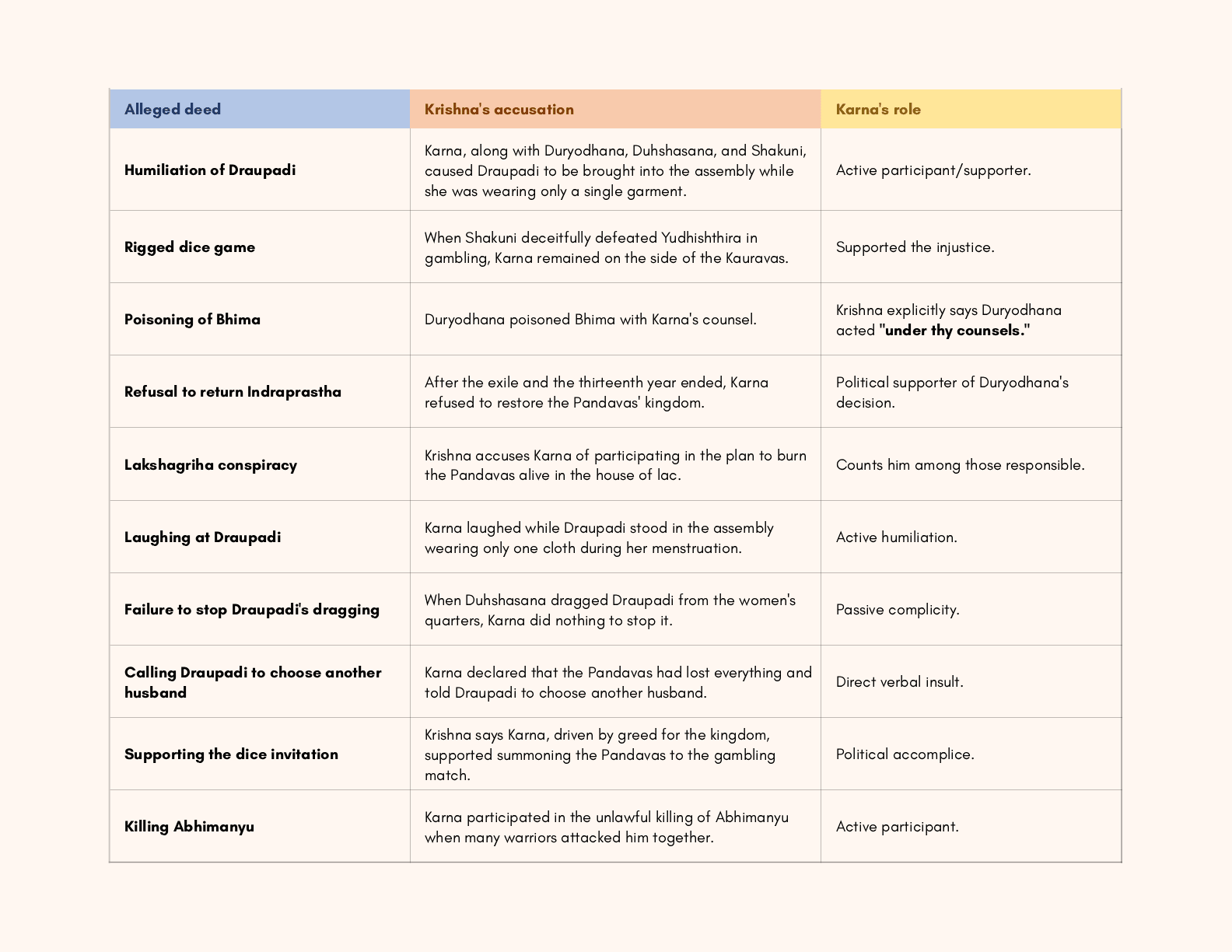
Here are some other wrongful acts that Lord Krishna reminded Karna of on the battlefield. Krishna spoke of these deeds directly to his face, and Karna lowered his head in shame, unable to deny them.
An Undefeated Warrior? Not Quite
Karna was undoubtedly an exceptional warrior. He defeated powerful kings such as Jarasandha and Kichaka, and both Lord Krishna and Lord Parashurama praised his skill in battle. However, many modern claims, such as Karna being stronger than Arjuna, losing only because he forgot the Brahmāstra, or pushing back Arjuna's chariot despite it being held by Krishna and Hanuman, are not supported by the Mahabharata. The famous chariot-pushing story does not appear in any major authentic version of the epic.
The Mahabharata also shows that Bhima1 2 3 was more than just a mace fighter. He was an excellent archer too. In several fights, he cut Karna's bow, killed his horses and chariot driver, destroyed his chariot, and forced him to switch to another one. Later, Karna beat Bhima in a fight but spared his life, because of a promise he had made to Kunti.
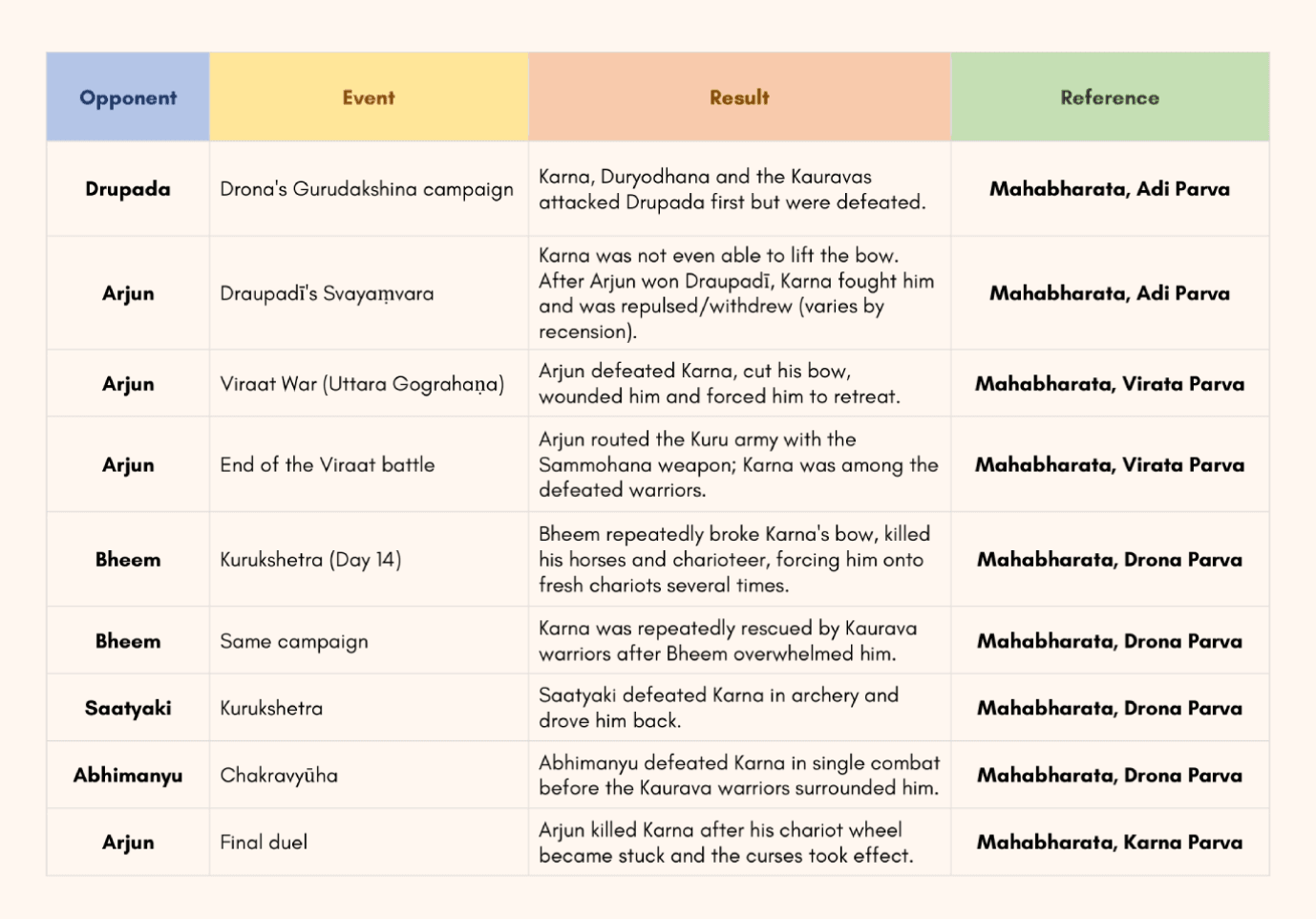
Likewise, Karna was repeatedly defeated by Arjuna. The claim that Arjuna won only because the gods helped him ignores events such as the Virata war, where Arjuna fought the entire Kuru army alone, including Bhishma, Drona, Karna, and other great warriors, and forced Karna to retreat. The Mahabharata records several occasions where Karna withdrew from the battlefield after being defeated. It is also worth noting that in all of these battles, including the Virata war and his earlier defeats, Karna still possessed his divine Kavacha and Kundala. He only gave those away before the Kurukshetra war. Here is a list of Karna's defeats. There is not a single recorded battle in the Mahabharata in which Karna defeated Arjuna.
Was He Even a Good Friend?
Karna stayed loyal to Duryodhana until the very end, no doubt about that. But the text also shows him as one of the people who pushed Duryodhana toward his worst decisions. Driven by his rivalry with Arjuna, Karna often gave Duryodhana false confidence, once claiming he could defeat "a hundred Arjunas and a hundred Krishnas." Through the story, he made big promises he could not keep.
In the Virat Parva, even Ashwatthama, someone close to Karna, criticized his empty boasting. Kripa, Drona, Bhishma, and Vidura made similar comments about him.
During the Gandharva battle, Karna fled the battlefield, leaving Duryodhana behind. It was Arjuna who later rescued him, and Karna himself admitted that he had retreated.
Later, when Lord Krishna came with a final peace proposal asking for just five villages, Karna supported Duryodhana's plan to arrest him. If a true friend is someone who constantly encourages the wrong path and fills you with false confidence, then Karna fits that description.
So, Was Karna Really Discriminated Against?
Based on the text itself, the popular image of Karna does not match what is written. He was not raised in poverty. He was not denied a proper education. He trained under the same teachers as the Pandavas and became one of the greatest archers of his time. His main struggles came from his own choices, like his obsession with beating Arjuna, the lie he told Parashurama, and the poor advice he kept giving Duryodhana.
Conclusion and What Karna Can Teach Us
Maybe the real lesson here is not about Karna at all. It is about us. If we are honest, most of us carry a small piece of Karna inside us. We chase approval the way he chased Arjuna's fame. We let one rivalry or one insult shape years of our own decisions. We give great advice to everyone else while ignoring our own warning signs, the same way Karna kept feeding Duryodhana false confidence instead of telling him the truth.
There is a bigger lesson too. We love a good emotional story, especially one about a poor, low caste hero who got a raw deal from the world. It feels satisfying to root for the underdog. But feeling something strongly is not the same as it being true. Many of us repeat these stories about Karna, or about other historical and religious figures, without ever opening the original text ourselves. We let movies, forwarded messages, and political propaganda write our beliefs for us, simply because the story fits what we already want to feel.
Reading the source directly is not about ruining a good story. It is about respecting the truth enough to check it before we repeat it. Karna's real story is already rich, complicated, and human, without anyone needing to twist it into a caste tragedy that the text itself never quite tells.