Lord Hanuman: The History, His True Form—Monkey or Human
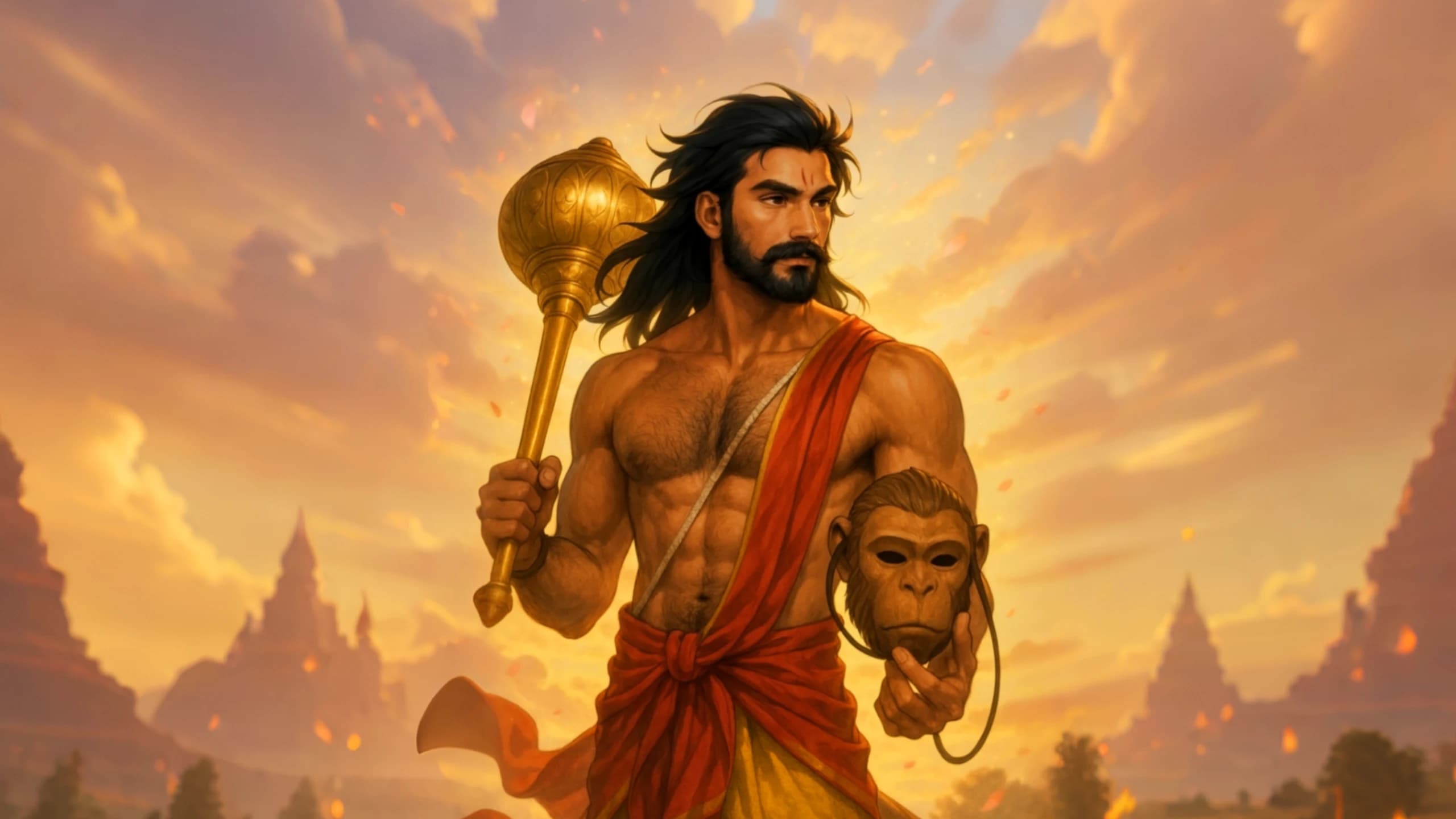
This article debunks the myth that Lord Hanuman was a monkey by presenting evidence from the Valmiki Ramayan that he was a human belonging to a warrior tribe known as the Vanaras. It explains that Hanuman was fluent in Sanskrit, could disguise himself as a Brahmin, and lived within a well-organized kingdom, all of which are characteristics that would be impossible for a monkey. The article also points out that Valmiki referred to the people of Kishkindha as Jan (humans) and their women as Stri, further reinforcing their human identity.
No audio available
Author: Eshan Singh
7 min read
·Published: 21 March, 2025
Lord Hanuman is one of the most powerful and intelligent characters in the Ramayan. Many people wrongly believe he was a monkey, but when we read the Valmiki Ramayan carefully, we find clear proof that he was not a monkey but a human from a special forest tribe called Vanaras.
Who Were the Vanaras
The Vanaras were not monkeys. Valmiki clearly states in Valmiki Ramayan (2.29.3) that they were
वनचारिणः
meaning "people who roamed in the forests". They were not a different race from city dwellers; their genetic roots were the same. They were physically strong and extremely intelligent.
वनं रमन्ते इति वानराः
Meaning: Those who dwell in the forest are called Vanaras. The word Vanara originally referred to forest dwellers, but over time, its meaning became limited to monkeys.
Vanaras Wore Disguises
Some Vanaras wore tails and headdresses like monkeys, just as some tribal communities today wear horns on their heads. But this does not mean they were monkeys. To verify this, we need to refer to the Kishkindha Kanda of the Valmiki Ramayan (Sarga 2, Verse 24), where Lord Sugriva instructed Lord Hanuman
तौ त्वया प्राकृतेनेव गत्वा ज्ञेयौ प्लवंगम।
He told Hanuman to remove his monkey attire and reveal his true form, which was human. And Lord Hanuman did so Valmiki Ramayan (4.3.2):
कपिरूपं परित्यज्य हनुमान् मारुतात्मजः
This means Hanuman discarded his monkey disguise and returned to his natural human form.
When Hanuman first met Lord Ram and Lakshmana, he changed his form to appear like a Brahmin.
सर्वथा चित्तविज्ञाने द्वाविमौ नरसत्तमौ
In Valmiki Ramayan (4.3.9), Hanuman says: "I see these two humans (Ram and Lakshman) and understand their minds". A real monkey cannot disguise itself as a Brahmin or understand human minds. This proves Hanuman was a human.
Vanaras Had Kings and Kingdoms
Vanaras had a structured society with kings, armies, and political strategies. This is not how real monkeys live. Valmiki Ramayan (4.4.27) says:
शासनं वानरेन्द्रस्य सुग्रीवस्य महात्मन:
Meaning: "This is the command of the great king of Vanaras, Sugriv". A kingdom with armies and rulers proves that Vanaras were an advanced tribe, not monkeys.
The Vanaras were not just ordinary forest dwellers; some of them were the sons of sages, proving their human origin.
महर्षिपुत्रं मारीचमर्चिष्मन्तं महाकपिम्
Valmiki Ramayan (4.42.3), says: "Arichiman, the Vanara, was the son of a sage and possessed great virtues like austerity, truth, patience, and control over senses." This confirms that many Vanaras were the offspring of Rishis, further proving that they were not monkeys but extraordinary humans with divine heritage.
ऋक्षीषु च तथा जाता वानराः किन्नरीषु च | देवा महर्षिगन्धर्वास्तार्थ्ययक्षा यशस्विनः॥ नागाः किंपुरुषाश्चैव सिद्धविद्याधरोरगाः। बहवो जनयामासुहृष्टास्तत्र सहस्रशः॥
According to Valmiki Ramayan (1.17.21), Some were Gandharvas, some were Kinners, some were Siddhas, and some were Vidyadharas. Many were Yakshas, Nagas, Garudas, and Kimpurushas. Filled with great joy.
In the Valmiki Ramayan, the inhabitants of Kishkindha were referred to as 'Jan' (people) and the women were referred to as 'Stri' (women). This linguistic detail further proves that they were regarded as human beings, not animals.
Hanuman Could Speak Sanskrit Fluently
Monkeys cannot speak, but Hanuman spoke in perfect Sanskrit. When he met Mother Sita in Lanka, she was shocked that a Vanara could speak like a wise man.
सुखोष्ठ: सुखदन्तश्च सुखनास: सुखानन: । सुखललाटनेत्रश्च सुखश्रोत्रकपालवान्॥
Meaning: "How can a monkey have such beautiful speech, knowledge of dharma, and wisdom?". Mother Sita doubted that a real monkey could speak so wisely. This proves Hanuman was not an animal. According to Valmiki Ramayan (4.3.28):
नानृग्वेदविनीतस्य नायजुर्वेदधारिणः। नासामवेदविदुषः शक्यमेवं विभाषितुम्॥ नूनं व्याकरणं कृत्स्नं अनेन बहुधा श्रुतम्। बहु व्याख्यात चान्येषां तद्विद्याः पद्मसंश्रयः॥
Meaning: "One who has not mastered the Rigveda, Yajurveda, and Samaveda cannot speak so fluently. He must have thoroughly studied Vyakarana (grammar) and explained it to others like a scholar". Here, Lord Ram appreciates Hanuman's vast knowledge of the Vedas and Sanskrit grammar.
Lord Ram acknowledges that Hanuman's way of speaking reflects deep knowledge and wisdom.
धर्मार्थसहितं वाक्यं व्यक्तं कर्णसुखं हितम् । उत्तरं सत्यसंयुक्तं व्यक्तार्थं च महाकपे॥
Meaning: "O mighty Hanuman! Your speech is righteous, logical, and clear. It is pleasant to the ears, beneficial, and filled with truth". Lord Ram praises Hanuman’s speech for being truthful, dharmic, and beneficial. These shlokas highlight how Lord Ram deeply admired Hanuman’s wisdom, intelligence, and knowledge of the scriptures.
Hanuman’s Tail Was an Ornament, Not a Real Tail
One of the biggest misconceptions about Hanuman is that he had a real, biological tail. However, a closer look at the Valmiki Ramayan suggests that Hanuman and the Vanaras wore tail-like ornaments or extensions as part of their traditional attire.
In the Sundar Kanda when Hanuman’s tail was set on fire by Ravana’s soldiers, Mother Sita prayed for it to remain unburned:
अनलश्चाप्यनाश: स्यात्तैलवृक्षप्रसादनात्।
According to (Sundar Kanda 53.4): "May the fire not harm Hanuman’s tail, as it is soaked in oil and prayers protect it."
This verse suggests that the tail was something external that could be oiled and burned, much like a cloth or an ornament. If it were a biological tail, it would not require oil treatment, nor would it be set on fire in the same manner.
कपीनां किल लाङ्गूलमिष्टं भवति भूषणम्
Additionally, in several instances, the Vanaras are described as wearing "tail ornaments", which were likely decorative extensions, similar to how tribal warriors in various cultures wear symbolic attire.
The Myth of Hanuman as an “Evolving Human” (Darwin’s Theory Misinterpretation)
Some people claim that Hanuman was a pre-human species that had not fully evolved into a modern human. They use Darwin’s theory of evolution as evidence to suggest that Vanaras were early human ancestors. However, this argument is flawed for several reasons.
Firstly, many modern researchers have questioned Darwin’s theory, pointing out its inconsistencies and lack of direct fossil evidence for gradual human evolution. But even if we accept Darwin’s theory, it only explains how apes could have evolved into humans. It does not explain other intelligent beings in the Ramayan, such as Jambavan (the bear king) or Jatayu (the vulture who spoke and fought Ravana).
If Hanuman was a "half-evolved human," then how do we explain Jambavan, who was a bear but had the wisdom of a sage? Or Jatayu, a vulture who spoke fluently, understood dharma, and bravely defended Mother Sita? These beings were not animals but highly evolved humans who dressed and identified with their tribal cultures.
Even today, many tribal communities wear costumes and accessories resembling animals, just as the Vanaras, Rikshas (bears), and Pakshis (birds) did in ancient times. Their attire symbolized their strength, role, or connection to nature, but it did not mean they were literal animals. Hanuman, Jambavan, and Jatayu were all extraordinary human beings with divine qualities, not part-animal, part-human creatures stuck in evolution.
This once again proves that Hanuman was not a monkey but a powerful human warrior from a special forest tribe.
Conclusion
The belief that Lord Hanuman was a monkey comes from later interpretations. However, a careful reading of the Valmiki Ramayan presents a different picture. It shows that Hanuman was a highly intelligent and powerful human belonging to the Vanara tribe. The Vanaras were not literal monkeys. They were forest-dwelling warriors known for their extraordinary strength and wisdom.
Hanuman's mastery of Sanskrit, his ability to plan and strategize, and his divine lineage all show that he was far beyond an ordinary animal. The Vanaras had organized kingdoms, established social structures, and even sages among them, all of which further support their human origins.
It is time to move beyond these misconceptions and understand Hanuman in his true form: an exceptional human with divine qualities, an unwavering devotee of Lord Ram, and a symbol of strength, wisdom, and devotion. By understanding his true identity, we can better appreciate his character and draw inspiration from his virtues as we strive to uphold dharma in our own lives.